

Challenge 5. “Create a fat that melts and resembles animal fat”
About Cocuus
COCUUS was born out of experience in the hospitality industry and a passion for technology and innovation, launching its professional journey in June 2017. Founded by Patxi Larumbe and Daniel Rico, and following careers in industrial machinery design, laser technology, and robotics, they took on the challenge of approaching the culinary world through mechatronics.
We created COCUUS because we want to be part of the food transition toward a healthier and more sustainable future for the planet. Because we believe that technology and delicious, healthy, and sustainable food are not only compatible, but must go hand in hand.
Since then, COCUUS has focused and specialized in the biosynthesis of meat alternatives, both plant-based and animal-derived. These are disruptive and innovative solutions for the industry, appealing to consumers, and environmentally friendly.
Check out Challenge 5, which COCUUS has submitted to the Open Innovation program.
Challenge 5. “Create a fat that melts and resembles animal fat”
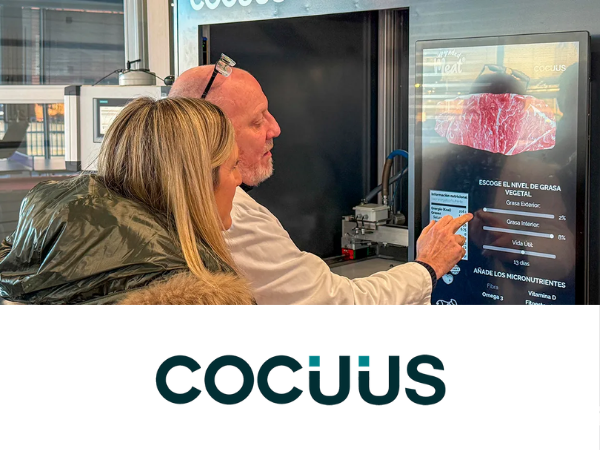
COCUUS is developing whole cuts of meat reformulated from meat streams using 3D printing. To create these products, the lean and fat components must be processed separately, replicating the characteristics of a natural cut.
Currently, in products such as chicken or pork bacon, the fat component is produced using an emulsion made from sunflower oil and other ingredients. However, this emulsion does not behave like real animal fat: it does not render properly when cooked in a pan, and it has limitations in terms of color, texture, and flavor compared to the reference fat.
The challenge is to develop a fat derived from plant sources, a hybrid plant-animal fat, or other alternatives that (1) melts during cooking and provides color, texture, and flavor similar to animal fat, (2) exhibits good adhesion and cohesion with the lean phase so that both phases remain bound together in the final product, (3) avoids the use of animal fats or highly hydrogenated fats (palm, shea) due to their high saturated fat content and unfavorable nutritional profile, and (4) can be developed in two versions, halal and non-halal, maintaining in both a list of ingredients that is as clean as possible (clean label) and free of major allergens. Hybrid animal-vegetable fat solutions are acceptable if they provide significant sensory or functional benefits.
Expected benefits
Implementing a solution in this area will enable Cocuus to make an impact across several key aspects of the business:
Closer to the real thing: cooking behavior, mouthfeel, and flavor that more closely resemble those of a conventional cut of meat, enhancing the consumer experience.
Improved nutritional profile and clean label: reduced use of animal fats and highly hydrogenated fats, lower saturated fat content, and shorter, more understandable ingredient lists.
Access to new markets: availability of halal and non-halal versions, free of major allergens, expanding the target audience and strengthening the product’s position on specialized shelves.
What are you looking for in a partner?
COCUUS is seeking startups, technology centers, and teams specializing in the formulation of fats and structured lipid systems that are capable of developing a functional fat capable of replicating the behavior, texture, and flavor of animal fat during cooking and integrating with the lean portion of the product.
The following will be given special consideration:
Experience in formulating structured fats: oleogels, advanced emulsions, plant-based or animal-plant hybrid lipid systems, or other technologies that enable the replicationof the melting point, color, texture, and flavor of animal fat without resorting to pure or highly hydrogenated animal fats (palm, shea).
Economic feasibility and cost control: the ability to propose solutions with raw material and processing costs that are consistent with the economics of the final product. This point is essential to the project’s viability.
Adhesion properties and compatibility with the fat-free phase: expertise in fat-protein interactions to ensure phase cohesion in products reformulated using 3D printing.
Halal and non-halal versions, clean-label and allergen-free options: the ability to develop both variants while maintaining short ingredient lists free of major allergens.
Vision for industrial scaling and collaborative work: focus on the end product, ability to iterate with the COCUUS R&D team, and validate the solution under real-world plant conditions.
Do you have any questions?
Write to us and we'll get back to you
The Open Innovation program is funded by
