

Challenge 7. “Separate the meat from the fat so that both can be used as raw materials”
About Cocuus
COCUUS was born out of experience in the hospitality industry and a passion for technology and innovation, launching its professional journey in June 2017. Founded by Patxi Larumbe and Daniel Rico, and following careers in industrial machinery design, laser technology, and robotics, they took on the challenge of approaching the culinary world through mechatronics.
We created COCUUS because we want to be part of the food transition toward a healthier and more sustainable future for the planet. Because we believe that technology and delicious, healthy, and sustainable food are not only compatible, but must go hand in hand.
Since then, COCUUS has focused and specialized in the biosynthesis of meat alternatives, both plant-based and animal-derived. These are disruptive and innovative solutions for the industry, appealing to consumers, and environmentally friendly.
Check out Challenge 7, which COCUUS has submitted to the Open Innovation program.
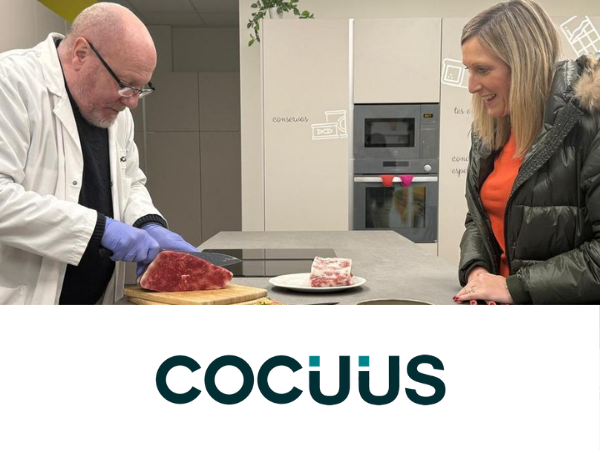
Challenge 7. “Separate the meat from the fat so that both can be used as raw materials”
Today, a large amount of meat is wasted during the butchering and cutting processes.
At COCUUS, we have developed and patented a technology to produce whole cuts (Txuletón, secreto, etc.) from these trimmings.
Finding a way to separate fat from meat allows us to reuse cuts of pork and beef that are currently discarded, and by removing the fat, we can replace it with healthier vegetable fats, resulting in products that are not only healthier but also add value to these trimmings.
Removing the fat from the meat would make it easier to brown the product and achieve the desired appearance in the final product. This would also allow us to avoid using lean meat.
COCUUS works with meat streams derived from butchering and off-cuts, which are highly heterogeneous: they include cuts with widely varying proportions of lean meat and fat, as well as tissues of varying quality.
This heterogeneity makes it difficult to utilize the lean fraction: the presence of fat alters the color and other properties of the final product, limiting the use of these streams in higher-value-added applications and relegating them to products such as low-end sausages or hamburgers.
The challenge lies in developing a technology capable of efficiently separating the lean phase from the fat phase within these streams, yielding two distinct raw materials that can be used separately: a lean fraction of higher quality and consistency for higher-value reformulations (whole cuts, premium products) and a fat fraction with known characteristics that can be used as a functional ingredient in other applications.
We are seeking technological solutions (mechanical, physical, enzymatic, or other) that are viable on an industrial scale, compatible with food safety requirements, and that preserve the functional integrity of the two fractions obtained.
Expected benefits
Implementing a solution in this area will enable COCUUS to make an impact across several key aspects of the business:
Better utilization of raw materials: separating the lean and fat fractions will allow each stream to be used in higher-value-added applications (whole cuts, premium products) rather than being used in lower-end products.
Greater quality control and consistency: having distinct, characterized fractions improves the standardization of color, texture, and other properties of the final product.
Efficiency and sustainability: optimizing the performance of available meat flows, in line with the principles of the circular economy and waste reduction throughout the value chain.
Healthier products and formulations that are more appealing to consumers.
A sustainable solution that maximizes the utilization of pork and beef.
What do you look for in a collaborator?
COCUUS is seeking startups, technology centers, and teams specializing in meat tissue separation technologies that can provide solutions for obtaining distinct lean and fat fractions from heterogeneous meat streams (off-cuts and trimmings), suitable for use as raw materials in value-added applications.
The following will be given special consideration:
Technical expertise in robotics and computer vision.
Ability to tailor solutions to a demanding industry such as the food industry.
A collaborative approach to jointly develop a realistic, scalable solution that aligns with COCUUS's objectives.
Meat-fat separation technologies: mechanical, physical, enzymatic, optical, or image-based approaches capable of distinguishing and separating lean meat from fat in heterogeneous meat streams (off-cuts, trimmings).
Compatibility with the food industry: solutions suitable for use in meat production, compliant with food safety regulations, and designed to preserve the integrity and functionality of the resulting fractions.
Industrial scalability: technologies capable of integrating into continuous process flows and scaling up to the volumes handled by COCUUS.
Collaborative co-development approach: willingness to work together with the COCUUS R&D team on process characterization, technology adaptation, and plant-scale validation.
Do you have any questions?
Write to us and we'll get back to you
The Open Innovation program is funded by
